
Μάθημα : Ενημέρωση φοιτητών κατεύθυνσης Αστροφυσικής
Κωδικός : PHYS352
Σεμινάριο Αστροφυσικής - Τετάρτη 11 Φεβρουαρίου 2026 - 16:00 (δια ζωσης)
Speaker: Prof. Nick Kylafis (University of Crete, Greece)
Speaker info: link
Title: "Pulsars and Magnetars: facts and possible fiction ?" 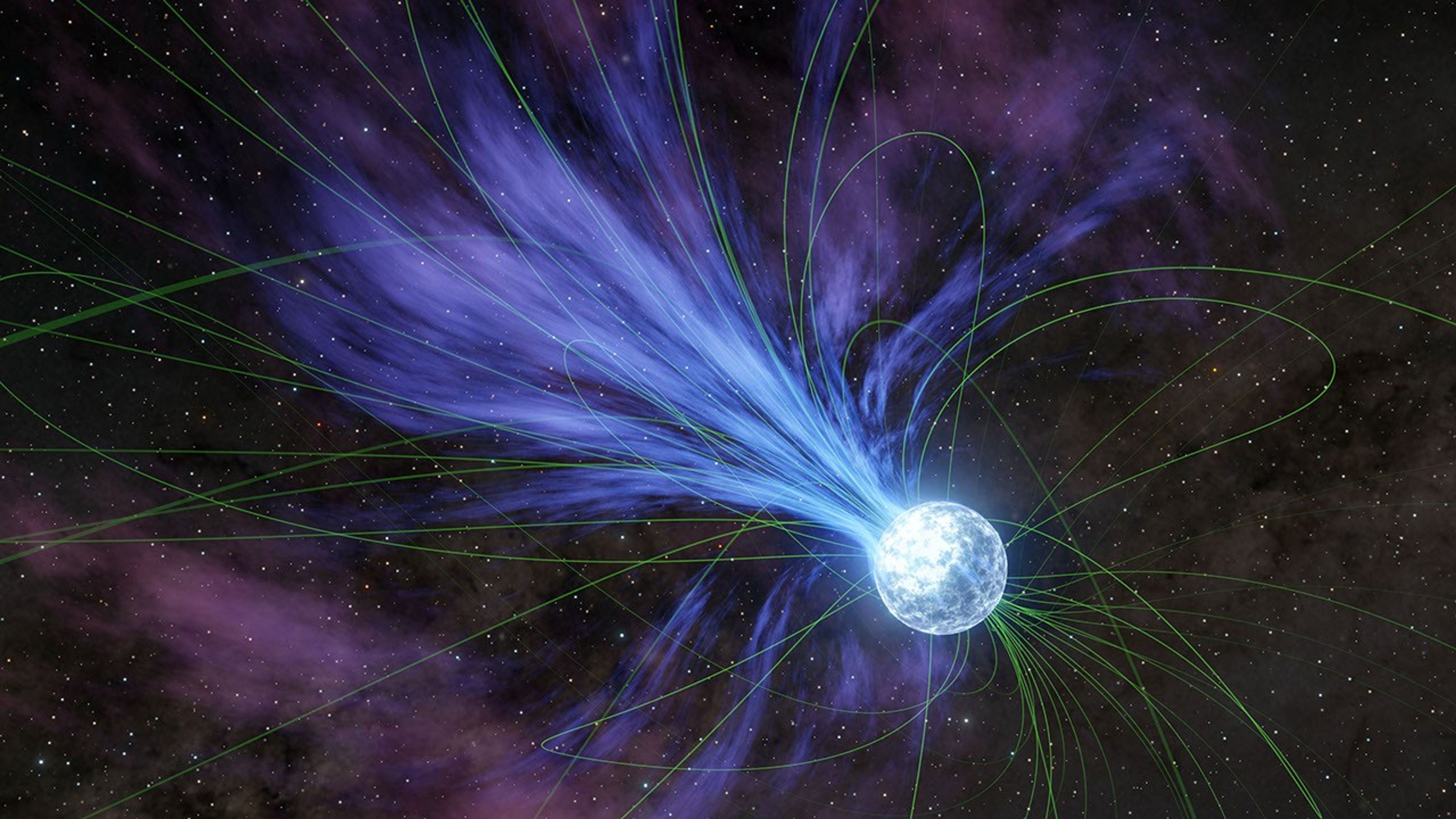
Abstract: Pulsars and Magnetars [i.e., Anomalous X-ray Pulsars (AXPs) and Soft Gamma-ray Repeaters (SGRs)] are believed to be isolated magnetic neutron stars. Pulsars have dipole magnetic fields of the order of $10^{12}$ G, while magnetars are thought to have dipole magnetic fields three orders of magnitude larger and even larger internal toroidal magnetic fields. Pulsars are relatively old, isolated neutron stars and it is therefore natural for them to rotate in vacuum. Magnetars, on the other hand, are relatively young isolated neutron stars and might be surrounded by matter left over from their formation. If this is the case, then their spin down may not be due to magnetic dipole emission, but rather due to the interaction between the magnetosphere of the neutron star and the surrounding matter. As a consequence, matter may fall along dipole magnetic-field lines onto the neutron star, producing X-ray emission. We have proposed that the quiescent and transient X-ray luminosity of AXPs and SGRs is the result of accretion from a fallback disk onto neutron stars with dipole magnetic fields in the range $10^{12} – 10^{13}$ G. Our picture is similar to that of normal X-ray pulsars; only the accretion rate is significantly smaller in AXPs and SGRs. Within the very stringent model of accreting pulsars, we have been able to explain quantitatively a) the comparable soft and hard X-ray luminosities, b) the X-ray spectra (soft and hard), c) the energy-dependent pulse profiles and d) the period derivative resulting from the accretion torque. Our model makes the prediction that no AXP/SGR will ever be observed with a hard X-ray power-law spectrum extending beyond 400 keV. The magnetar model, on the other hand, allows the power law to extend to 1 MeV or more. For the outbursts with super-Eddington luminosities, our model proposes that they are produced by magnetic field decay in localized, super-strong ($10^{14} – 10^{15}$ G) multipole fields. The extent of the X-ray power law and the existence or non-existence of fallback disks around magnetars will decide whether the accretion picture or the classical magnetar picture is the correct one.